Paris Neighbourhoods Guide for International Buyers: Beyond the Clichés
18 avril 2026 · Sarah & Sabine
Paris is one of the world's most studied, mapped and debated cities, yet it continues to surprise even the most experienced observers. For international buyers, choosing the right neighbourhood is not a lifestyle preference. It is a capital allocation decision that determines your yield profile, your exit liquidity, your tax exposure, and your long-term wealth trajectory in one of the world's most resilient property markets.
The clichés are seductive and expensive. The fantasy of the Left Bank pied-à-terre, the 16th arrondissement family address, the Marais hôtel particulier — these narratives persist because they contain genuine truth. But they are incomplete, and acting on them without granular local knowledge is precisely how international buyers overpay, underperform, and end up holding assets that serve the market's interests rather than their own.
This guide provides an alternative: a structured, data-informed reading of Parisian geography as it actually functions for buyers, not tourists. It is written from the perspective of advisers who work exclusively on the buyer side, and it reflects what we actually tell our clients before they commit capital.
What Is a Paris Neighbourhood?
The Arrondissement System Explained
Paris is divided into 20 arrondissements, each functioning as an administrative district with its own mayor, services and postal code. The arrondissement system was established in its current form by Baron Haussmann during the great urban transformation of the Second Empire, formalised in 1860. For visitors and buyers alike, understanding this system is the first step toward navigating the city intelligently.
Each arrondissement has a number between 1 and 20, and a corresponding postcode: the 1st arrondissement is 75001, the 10th is 75010, and so on through to 75020. The number alone communicates a great deal, including approximate location, prestige level and real estate pricing band.
Arrondissements vs. Neighbourhoods vs. Quartiers
These three terms are often used interchangeably, but they refer to distinct realities:
- Arrondissement: The official administrative unit. There are exactly 20 of them.
- Quartier (quarter): A subdivision within an arrondissement, often defined by historical character, architecture or community identity. Paris officially recognises 80 quartiers.
- Neighbourhood: An informal, lived concept. “Le Marais” is both a quartier and a neighbourhood that spills across the 3rd and 4th arrondissements. “Montmartre” is technically within the 18th, but it has its own gravitational identity.
For practical purposes, this guide uses “neighbourhood” and “quartier” interchangeably when referring to named areas, while “arrondissement” refers specifically to the numbered districts.
The “Snail” Map: Reading Paris Arrondissement Numbers
The arrondissements spiral outward from the city centre in a clockwise pattern, which is why Parisians call it the plan en escargot (snail plan). The 1st sits at the very heart, occupying the Right Bank around the Louvre. Numbers increase as you spiral outward: the 2nd, 3rd and 4th complete the inner core, while the 19th and 20th occupy the northeastern edge.
This matters practically: lower numbers generally indicate greater centrality, higher land values, and denser tourist infrastructure. Higher numbers are not necessarily less desirable, but they require more local knowledge to evaluate correctly.
The Notarial System and Why It Matters
Paris operates on a notarial system in which every transaction is validated by a notaire, a state-appointed civil law officer who acts simultaneously for both parties and for the state. This is structurally different from the common law conveyancing systems familiar to British and American buyers, and from the agency-dominated models of Gulf markets. The notaire does not act as a buyer's solicitor. Independent advisory — the role of a conseil acquéreur or property hunter — fills a gap that most international buyers do not initially realise exists.
Understanding this from the outset changes how you approach neighbourhood selection. Because the agent works for the seller and the notaire works for the transaction, the buyer who arrives without their own adviser is the only party in the room without an aligned advocate.
Reading Price Data Honestly
All price data in this guide is derived from DVF (Demandes de Valeurs Foncières), the French government's open transaction database recording every completed sale at notarised price. This is more reliable than agency-quoted asking prices, which systematically overstate market levels by between 8% and 15% in a normalising market environment. When an agent tells you a neighbourhood is "around €12,000/m²," the DVF frequently tells a different story.
1st — Louvre, Les Halles & Palais-Royal
Buyer profile: Trophy asset, institutional-grade capital preservation.
The 1st is Paris's geographic and symbolic heart. It is also one of the least liquid markets for individual buyers: stock is extremely limited, transaction volumes are low, and when assets do come to market, competition is intense and pricing reflects it. Average prices sit at the upper end of the Parisian range, typically €13,000 to €15,000/m² for standard product, higher for exceptional addresses.
The investment case rests entirely on capital preservation and prestige rather than yield. Gross rental returns in the 1st are typically sub-2.5%. Buyers here are not seeking income; they are seeking an address with unimpeachable long-term value. The Palais-Royal perimeter and the Île de la Cité adjacency justify premium within the premium.
What the sales brochure will not tell you: Les Halles, the northern section of the 1st around the Forum, has a significantly different character from the Palais-Royal and Tuileries zones. Street-level quality, tenant profiles, and future resale values vary considerably within the same arrondissement.
2nd — Montorgueil, Sentier & Bourse
Buyer profile: Value-oriented buyers seeking central exposure with yield upside.
The 2nd is Paris's smallest arrondissement and one of its most undervalued by international buyers. The Sentier district, once the textile trade heartland, has repositioned as a creative and technology hub — a transformation that has driven sustained demand from a higher-income, younger professional tenant base.
Pricing is meaningfully below the 1st and 6th while offering comparable centrality. The Montorgueil corridor, a functioning daily-life market street with strong residential demand, provides the kind of address that translates well to furnished rental yields in the LMNP regime.
Investment note: The 2nd has seen consistent 4% to 6% annual price appreciation in the five-year period to 2024. For buyers seeking a Paris address with genuine yield potential and a credible appreciation trajectory, it deserves serious consideration that it rarely receives.
3rd — Upper Marais & Temple
Buyer profile: Design-conscious buyers targeting Marais exposure without 4th arrondissement pricing.
The 3rd occupies the northern half of the historic Marais. It is quieter and more residential than the 4th, with a strong concentration of contemporary art galleries and a professional tenant base oriented toward the creative sector. Pricing is typically 10% to 15% below equivalent product in the 4th, with comparable fundamentals.
What the data shows: The gap between the 3rd and 4th has narrowed consistently over the past decade. Buyers who entered the 3rd five years ago on the argument that Marais character at a discount was a structural opportunity have been validated. The argument is less compelling today than it was, but it has not entirely closed.
4th — Le Marais, Île de la Cité & Île Saint-Louis
Buyer profile: Premium capital preservation, strong international resale market.
The 4th is one of the most layered arrondissements in Paris: medieval islands, the preserved Jewish quarter on Rue des Rosiers, and the best concentration of 17th-century architecture in the city. It survived Haussmann's demolitions because it was considered too poor to warrant investment at the time — a remarkable accidental conservation that created irreplaceable urban fabric.
Today, the 4th commands premium pricing that is justified by genuine scarcity. Hôtels particuliers in the Marais represent some of the most internationally recognised real estate assets in France. Île Saint-Louis, a small island in the Seine, offers an extraordinary combination of central location and residential calm that has no comparable elsewhere in Paris.
Structural note: International buyer demand in the 4th is genuinely global — American, British, Gulf, Asian. This diversification of demand base insulates the market from any single source of volatility. Liquidity on exit is among the highest in Paris.
5th — The Latin Quarter
Buyer profile: Long-stay investors and buyers with interest in student rental income or Left Bank prestige at below-6th pricing.
The Latin Quarter's layering of Roman ruins, medieval universities, and 19th-century academic architecture makes it structurally unique in the Paris market. The Sorbonne concentration creates sustained rental demand from the upper end of the academic and postgraduate market. Pricing is materially below the 6th for comparable addresses.
Consideration for non-residents: Student tenancy regulations in France afford tenants meaningful protections. Buyers targeting furnished short-term rental income via LMNP status will find the 5th more operationally manageable than longer-term furnished tenancy arrangements.
6th — Saint-Germain-des-Prés
Buyer profile: Conservative premium capital, portfolio anchor, trophy Left Bank address.
Saint-Germain is the arrondissement that most closely matches the international financial imagination of a Paris real estate position: literary prestige, architectural consistency, and the kind of address that requires no explanation in any language. It is also one of the most expensive arrondissements in the city, and one of the most price-resilient across market cycles.
Gross yields are low — typically between 2.0% and 2.8% on standard residential product — reflecting the premium already embedded in acquisition costs. The investment case is not income; it is the asymmetric downside protection of a genuine global safe-haven address.
The Jardin du Luxembourg adjacency, the calibre of co-owners typically encountered in 6th arrondissement buildings, and the quality of the physical environment all contribute to a product that holds value when other Parisian markets correct.
For serious buyers: The 6th is where Maison Arboris most frequently identifies pricing inefficiencies — not at the headline level, which is efficiently priced, but at the asset level, where atypical floor plans, overlooked courtyard-facing apartments, and buildings with recently voted ravalement can represent genuine value relative to their long-term positioning.
7th — Eiffel Tower, Musée d'Orsay & Gros Caillou
Buyer profile: Families, diplomatic community, conservative long-term holders.
The 7th is residential, elegant and genuinely quiet for an arrondissement containing the Eiffel Tower. The Gros Caillou quartier — the streets southeast of the tower — constitutes some of the finest Haussmannian urbanism in Paris: consistent facades, generous volumes, and a permanent population with the income levels to maintain them.
For family buyers evaluating Paris as a primary or secondary residence rather than a pure investment vehicle, the 7th offers the combination of school access, green space proximity, and safety record that few other arrondissements can match at scale.
Flood risk note: Certain sections of the 7th fall within the Paris flood risk perimeter (PPRI). The 2016 Seine floods reached 6.1 metres. This is not a theoretical risk, and it should be factored into due diligence for any ground-floor or basement-level acquisition in flood-mapped streets.
8th — Champs-Élysées, Madeleine & Golden Triangle
Buyer profile: Luxury, flagship addresses, prestige commercial adjacency.
The 8th is Paris's grand axe: the Champs-Élysées, the Arc de Triomphe, and the haute couture concentration of Avenue Montaigne. It contains the highest density of luxury hotels per square kilometre in Europe and some of the city's most significant gastronomic institutions. For buyers seeking prestige residential addresses with global name recognition, the 8th delivers.
The Parc Monceau perimeter in the northwestern section of the arrondissement is a specific market worth understanding separately: quieter, more residential, with generously proportioned Haussmannian stock and a buyer profile that skews toward established European and Gulf wealth.
Investment calibration: Pricing in the 8th is high and yield is low. The case for the 8th is made on prestige and demand robustness rather than return metrics. Buyers who approach the 8th seeking yield will find the 10th, 11th, or 13th significantly more rewarding.
9th — Opéra, Grands Boulevards & South Pigalle
Buyer profile: Mid-range buyers with appetite for gentrification upside.
The 9th has one of the most favourable risk/return profiles currently available in inner Paris. The northern section, South Pigalle (SoPi), has undergone a decade of consistent gentrification: the bar and restaurant density that signals neighbourhood momentum is firmly established, and the residential market has responded with sustained appreciation. The southern section, closer to the Grands Boulevards, offers excellent connectivity at pricing that still trails the prestige arrondissements materially.
The Palais Garnier catchment area in the southern 9th is a specific pocket of interest: consistent international visitor demand, strong short-term furnished rental performance, and the kind of central address that translates to global audiences.
10th — Canal Saint-Martin & Gare du Nord
Buyer profile: Appreciation-focused buyers with medium-term horizon, informed value position.
The 10th divides into two distinct market environments. The Gare du Nord and Gare de l'Est corridor is utilitarian and transit-oriented — acquisition pricing is lower, but so is the quality of the permanent residential market. The Canal Saint-Martin corridor, by contrast, is one of the most photographed urban environments in Paris and has generated some of the most consistent appreciation data in the DVF record over the past decade.
DVF data shows that the Canal Saint-Martin zone has experienced annual price growth in the 4% to 5.5% range over the five-year period to 2024. For buyers with a medium-term horizon and the patience to identify the right asset, this is one of the most intellectually honest value propositions in the Paris market.
Eurostar consideration: The Gare du Nord adjacency is a structural argument for certain buyer profiles — specifically British buyers who intend to use a Paris apartment for regular extended stays. The two-hour twenty-minute direct connection from London St Pancras is a genuine convenience that is underpriced in the market's current assessment of the 10th.
11th — Bastille, Oberkampf & République
Buyer profile: Yield-focused buyers, furnished rental investors, culturally engaged international owners.
The 11th is consistently cited by knowledgeable Parisians as the best arrondissement in the city for quality of life per euro spent. It concentrates the highest density of acclaimed independent restaurants, natural wine bars, and late-night venues in Paris. Its residential market reflects this: demand from the 30 to 45 demographic is structural and growing.
For LMNP investors, the 11th offers a combination of strong furnished rental demand, reasonable acquisition pricing relative to the centre, and appreciation supported by underlying lifestyle desirability. Gross yields on well-positioned furnished product can approach 4.0% to 4.5%.
Exit liquidity note: The resale market in the 11th has deepened significantly over the past decade as buyer awareness has caught up with the neighbourhood's actual quality. Liquidity on exit is meaningfully better than it was five years ago, and the trend is continuing.
12th — Gare de Lyon, Aligre & Charonne
Buyer profile: Value-focused residential investors and buyers prioritising green space access.
The 12th is one of Paris's most underestimated arrondissements from an investment standpoint. The Marché d'Aligre — a covered hall with an adjacent outdoor flea market — represents the most authentic market environment in Paris, and its catchment supports a strong permanent residential community. The Promenade Plantée (Coulée Verte), a linear park on a former elevated railway viaduct, predates New York's High Line by over a decade and remains one of the most pleasurable urban walking environments in the city.
Pricing in the 12th is meaningfully below the 4th and 11th while offering genuine urban quality. For buyers seeking a long-hold residential position in inner Paris without competing against international trophy buyers, it deserves serious attention.
13th — Place d'Italie, Butte aux Cailles & Bibliothèque
Buyer profile: Yield-optimised investors, long-hold value position.
The 13th provides the best current gross yield profile among the inner arrondissements. In furnished rental under LMNP status, certain pockets — particularly around the Bibliothèque François Mitterrand and the Butte aux Cailles quartier — are generating gross yields approaching 4.5% to 5.5%.
The riverside Bibliothèque corridor is a specific market worth watching: a growing cluster of cultural institutions, the Docks de Paris development, and riverside bar infrastructure have created a demand dynamic that is early in its maturation relative to Canal Saint-Martin, which it structurally resembles.
Consideration for yield-focused buyers: Higher yields in the 13th must be evaluated against longer resale timelines relative to prestige addresses. This is not a liquid market in the way the 6th or 4th are. Buyers should model a minimum five-year hold.
14th — Montparnasse & Denfert-Rochereau
Buyer profile: Practical mid-range position, strong connectivity.
The 14th carries the faded glamour of interwar Montparnasse — the artistic and intellectual associations of Picasso, Modigliani, and Hemingway are still embedded in the built environment — but its contemporary investment case rests on more prosaic fundamentals: excellent Métro connectivity, genuine residential character, and mid-range pricing with stable demand.
The Montparnasse TGV station makes the 14th disproportionately convenient for buyers with connections to Brittany, Bordeaux, and the Atlantic coast. For buyers maintaining a primary residence in the west of France, the 14th functions as a well-positioned Paris base at below-premium pricing.
15th — Javel, Bir-Hakeim & Convention
Buyer profile: Family buyers, long-stay users, conservative residential investors.
Paris's most populous arrondissement is almost entirely residential, safe, well-served by the Métro, and offers some of the best value accommodation in inner Paris relative to what it delivers in quality of urban environment. The Parc André Citroën on the Seine is a genuine landscape architecture achievement. The Bir-Hakeim bridge view is one of the most photographed vantage points in the city.
For international families evaluating Paris as a primary or secondary residence with school-age children, the 15th offers the combination of space, safety, school network access, and reasonable acquisition pricing that the 7th and 16th deliver at higher cost.
16th — Passy, Trocadéro & Bois de Boulogne
Buyer profile: Conservative family capital, discretionary wealth, Gulf buyers with school priorities.
The 16th is old money Paris: discreet, architecturally impeccable, and structurally oriented toward families with children and wealth that does not require display. The Art Nouveau and Art Deco buildings in Passy and Auteuil are among the finest in the city. The school network — including several of the most selective international options in Paris — is a genuine pull factor for Gulf and international buyers with children of school age.
The Trocadéro esplanade offers the best postcard view of the Eiffel Tower. The Fondation Louis Vuitton (Frank Gehry building) has added cultural gravity to the Bois de Boulogne edge.
Market note: The 16th has historically been one of the more illiquid luxury markets in Paris — high prices, long transaction timelines, and a buyer pool that is deep but not wide. The market has shown more activity in recent years as younger family buyers have entered, but it remains fundamentally a long-hold proposition.
Within-arrondissement variance: The gap between Auteuil (southern, Art Nouveau, school zone) and the northern strip toward La Muette is significant — both in terms of architecture and underlying demand. Due diligence on specific streets matters considerably in the 16th.
17th — Batignolles & Ternes
Buyer profile: Transition-oriented buyers, family buyers priced out of the 8th.
The 17th splits between the bourgeois Ternes side — western, adjacent to the 8th — and the increasingly dynamic Batignolles neighbourhood, which has its own village character around a genuine square and an organic Saturday market. The Clichy-Batignolles eco-district development on the northeastern edge has introduced new housing stock and attracted a younger professional buyer profile, with commensurate effects on pricing momentum.
For buyers seeking the gravitational pull of the 8th at a meaningful discount, the eastern 17th — particularly the Batignolles corridor — represents a credible transitional neighbourhood investment.
18th — Montmartre, Pigalle & Barbès
Buyer profile: Informed buyers willing to manage within-arrondissement variance, creative sector landlords.
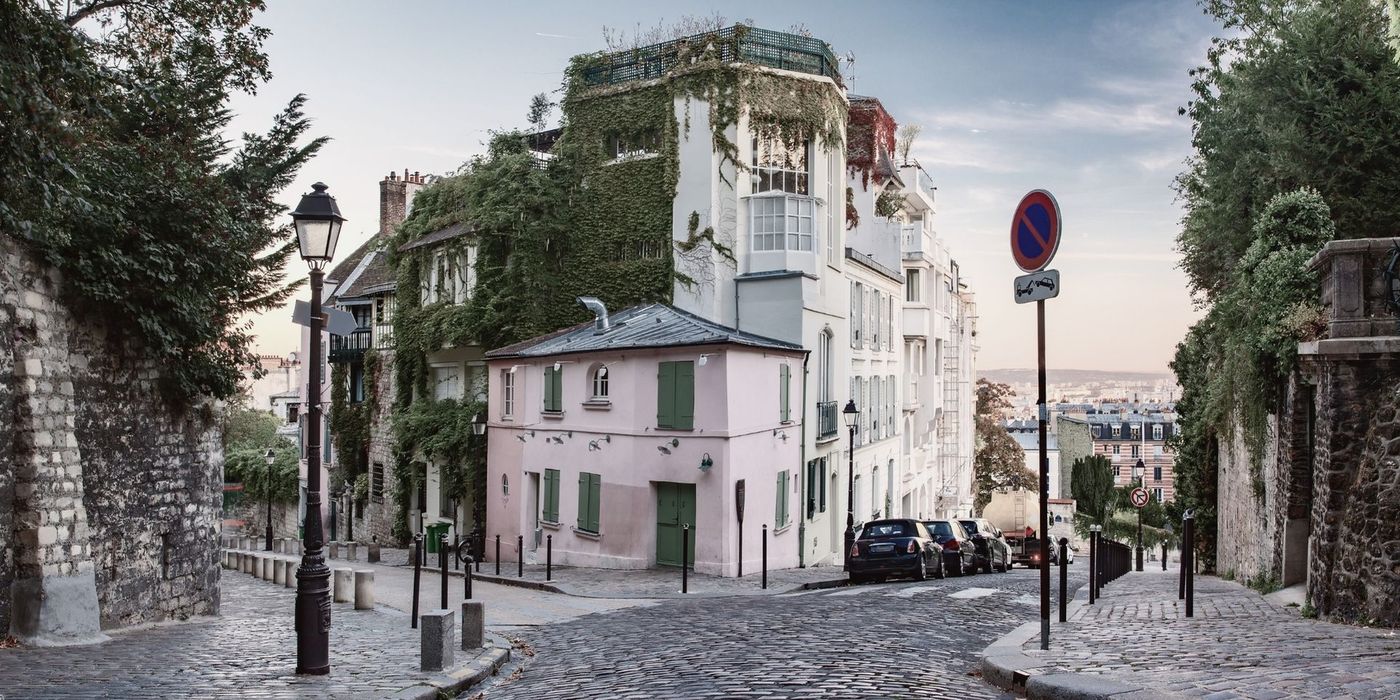
The 18th is the arrondissement of extremes. Montmartre delivers the village-above-the-city atmosphere that has made it one of the most recognisable neighbourhoods in the world, with cobblestone streets, surviving vineyards, and the white dome of Sacré-Cœur as skyline anchor. The butte's elevated position and Art Nouveau building stock create genuine scarcity.
Pigalle has been substantially transformed from its former identity: the music venue and bar density is now among the highest in Paris, and residential demand from the creative and media sector has driven sustained appreciation on the right streets. Barbès is a densely multicultural market corridor — authentically Parisian, but a different proposition entirely.
What the headline data obscures: Within-arrondissement price variance in the 18th is among the highest in Paris. The gap between a well-positioned Montmartre apartment and a street-level flat on the Barbès corridor can exceed €3,000/m². Neighbourhood due diligence at the street level is non-negotiable here.
19th — La Villette & Buttes-Chaumont
Buyer profile: Early-stage long-term investors, yield-seeking non-residents.
The 19th is Paris's most undervalued arrondissement from a quality-of-life standpoint, and arguably from an investment standpoint as well. The Parc des Buttes-Chaumont is arguably the most beautiful public park in the city. The Parc de la Villette complex — Cité des Sciences, La Géode, Philharmonie de Paris — anchors the northern section with a cultural infrastructure that commands genuine international attention.
Gross yields in furnished rental in the 19th approach 4.5% to 5.5% in certain pockets. Acquisition pricing remains below the inner arrondissements. The structural narrative — quality parks, improving cultural infrastructure, good Métro coverage, sustainable pricing — is coherent, even if the timeline for appreciation materialisation requires patience.
20th — Belleville, Ménilmontant & Gambetta
Buyer profile: Frontier position, highest risk/highest potential return within the Périphérique.
The 20th is Paris's most genuinely multicultural arrondissement and its most contested investment narrative. Belleville, straddling the 19th and 20th, is simultaneously the centre of Paris's Chinese community, its North African community, and its most active street art environment. Père Lachaise adds an unexpected layer of historical prestige. Ménilmontant has a steep, village-like topography that creates genuine scarcity in its best streets.
The 20th, particularly the Belleville and Ménilmontant corridors, is the frontier position in the Paris market: higher risk, longer resale timelines, but a potential appreciation trajectory that has already partially materialised in the upper Belleville streets and continues to work its way through the arrondissement.
For buyers comfortable with illiquidity: Entry pricing in the 20th provides access to inner-Paris exposure at a material discount to established addresses. The investment case requires a genuine five-to-ten-year hold and a realistic assessment of resale liquidity.ied-à-terre, the 16th arrondissement family address, the Marais hôtel particulier — these narratives persist because they contain genuine truth. But they are incomplete, and acting on them without granular local knowledge is precisely how international buyers overpay, underperform, and end up holding assets that serve the market's interests rather than their own.
This guide provides an alternative: a structured, data-informed reading of Parisian geography as it actually functions for buyers, not tourists. It is written from the perspective of advisers who work exclusively on the buyer side, and it reflects what we actually tell our clients before they commit capital.
Investment Profiles: Arrondissements by Objective
Trophy Asset / Capital Preservation
The 6th, 7th and 8th arrondissements have demonstrated the most consistent price resilience across market cycles. Properties here rarely lose value in nominal terms and benefit from international demand that insulates them from domestic economic cycles. The trade-off is low gross rental yield — typically between 2.0% and 2.8% — reflecting the premium already embedded in acquisition pricing.
Value + Appreciation Potential
The 10th, 11th and 20th arrondissements represent the strongest current combination of value and medium-term appreciation trajectory. DVF data shows the 10th and 11th experiencing consistent annual price growth in the 3.5% to 5.2% range over the five-year period to 2024. The 20th is the frontier position: higher risk, higher potential return.
Yield-Optimised Investment
For buyers whose primary objective is rental income rather than capital gain, the 19th and 13th provide the best current yield profile, with gross yields in furnished meublé rental approaching 4.5% to 5.5% in certain pockets. This must be evaluated against longer resale timelines than prestige addresses provide.
Key Legal and Tax Structures for Non-Resident Buyers
SCI (Société Civile Immobilière)
A civil real estate holding company used to hold French property. The SCI is not a trading entity but a transparent vehicle that simplifies succession planning and facilitates joint ownership between partners or family members. Under French law, SCI shares are subject to different inheritance rules than direct property ownership — particularly relevant for buyers from common law jurisdictions where the concept of tenants in common does not translate directly into French civil law.
Démembrement (Usufruct / Bare Ownership)
A structure in which the right to use a property (usufruct) is legally separated from ownership of the capital (bare ownership). This is a legitimate and widely used tool for tax optimisation and intergenerational wealth planning. A bare ownership purchase in a premium arrondissement can represent a significant discount to full market value, with full consolidation at the end of the usufruct period.
LMNP (Loueur en Meublé Non Professionnel)
A tax status available to non-resident landlords letting furnished properties. Under LMNP, taxable income can be reduced by depreciation allowances on both the building and furniture, significantly improving after-tax yield relative to unfurnished letting. For international buyers targeting income from their Paris acquisition, LMNP is typically the most advantageous regime to structure around.
Due Diligence: What Estate Agents Will Not Volunteer
At Maison Arboris, our due diligence process covers dimensions that standard estate agents rarely address:
Charges de copropriété (condominium charges): In older Haussmannian buildings, these can be extraordinarily high — particularly if a ravalement (façade restoration) or elevator installation has been voted by the co-owners' assembly but not yet completed. Always request the last three years of assembly minutes (procès-verbaux d'assemblées générales) before exchanging.
Servitudes and heritage classification: Buildings classified as Monuments Historiques, or located within a heritage protection zone (AVAP or PSMV), carry restrictions on modification that affect both renovation projects and future resale positioning. The 4th, 6th and 7th have significant concentrations of protected buildings.
PLU (Plan Local d'Urbanisme): The local zoning plan governs what can be built or modified in any given zone. For buyers considering development, extension, or change-of-use projects, the PLU is a non-negotiable preliminary document.
Flood risk mapping: Certain sections of the 1st, 4th, 7th and 15th arrondissements fall within the Paris flood risk perimeter (PPRI). The 2016 events, in which the Seine reached 6.1 metres, demonstrated this is not theoretical.
DVF transaction history: Understanding what the specific building — not just the arrondissement — has transacted at historically is essential calibration that agencies with seller mandates have no incentive to provide.
Getting Around Paris: How Neighbourhood Connectivity Affects Investment Decisions
The Paris Métro is one of the densest urban rail networks in the world — 16 lines, 302 stations, and a maximum walking distance between central stations of approximately 500 metres. For practical purposes, no arrondissement within the Périphérique is poorly connected in absolute terms. But connectivity quality, and specifically Métro line quality and major interchange access, materially affects rental demand and therefore yield.
Key transport hubs that buyers should factor into neighbourhood evaluation:
Châtelet-Les Halles (1st/4th): The largest interchange in the network, connecting lines 1, 4, 7, 11, 14 and multiple RER lines. Properties within walking distance of this hub command a structural rental premium.
République (3rd/10th/11th): Connects lines 3, 5, 8, 9 and 11. The proximity argument for eastern arrondissement acquisitions runs through this station.
Saint-Lazare (8th): The major northwestern hub with mainline rail connections — relevant for buyers with Normandy or international rail dependencies.
RER A and B: East-west and airport connectivity respectively. RER A corridor proximity is a genuine rental demand driver; RER B provides the CDG and Orly access that matters for furnished short-term rental performance.
The Maison Arboris Approach
At Maison Arboris, our role is to translate complexity into clarity. We work exclusively on the buyer side — no seller mandates, no developer relationships, no commissions from any party other than our client. This structural alignment is not incidental to the quality of our advice; it is its precondition.
Whether you are evaluating the 6th and the 7th for a capital preservation position, or choosing between a Marais hôtel particulier and a Canal Saint-Martin apartment for a yield-oriented portfolio, the decision framework is the same: define your objectives precisely, interrogate the data honestly, and engage advisers whose interests are structurally aligned with yours.
Paris rewards this approach consistently. The buyers who have performed best in this market over the past two decades are those who arrived with clear capital objectives, credible local intelligence, and the patience to wait for the right asset rather than the available one.
Maison Arboris is an independent real estate advisory firm operating exclusively on the buyer side. We advise high-net-worth international clients on property acquisitions across Paris and France. All price data referenced in this article is derived from DVF (Demandes de Valeurs Foncières) transaction records.
Questions fréquentes
01Which Paris neighbourhood offers the best real estate investment returns?
Which Paris neighbourhood offers the best real estate investment returns?
The 10th, 11th, and 20th arrondissements currently offer the strongest combination of value and appreciation potential, with annual price growth of 3.5–5.2% through 2024. The 19th and 13th deliver the highest furnished rental yields (4.5–5.5%), while the 6th, 7th, and 8th provide the greatest long-term capital preservation.
02Do I need a buyer's agent to purchase property in Paris as a foreigner?
Do I need a buyer's agent to purchase property in Paris as a foreigner?
Legally, no. In practice, the absence of independent buyer-side representation is one of the most common and costly mistakes international buyers make in the Paris market. The notaire acts for the transaction and the state, not for your interests. The estate agent holds a seller mandate. A conseil acquéreur — or property hunter — is the only party in the room whose fee is structurally contingent on your satisfaction with the outcome.
03How do I assess whether a Paris property is fairly priced?
How do I assess whether a Paris property is fairly priced?
The only reliable benchmark is DVF (Demandes de Valeurs Foncières) the French government's open transaction database recording every notarised sale at its actual price. Agency asking prices systematically overstate market levels by 8% to 15% in a normalising environment. Cross-referencing the DVF against the specific building's transaction history, the street's pricing band, and comparable recent sales in the same quartier gives you the analytical foundation that a buyer-side adviser uses to assess and negotiate. Asking price alone is not a data point; it is a negotiating position.
04What taxes apply when buying property in Paris as a non-resident?
What taxes apply when buying property in Paris as a non-resident?
The principal acquisition cost beyond the purchase price is the droits de mutation, colloquially called frais de notaire, which represent approximately 7% to 8% of the purchase price on existing property (resale) and around 2% to 3% on new-build. Non-residents are additionally subject to French income tax on rental income at a minimum rate of 20%, though the LMNP regime and applicable tax treaties — particularly with the US, UK, and Gulf states — can substantially reduce the effective burden. IFI (Impôt sur la Fortune Immobilière), France's wealth tax on real estate assets, applies to non-residents holding French property above the €1.3 million threshold.
05Where do most American expats live in Paris?
Where do most American expats live in Paris?
American expats in Paris tend to concentrate in the 6th, 7th, 8th, and 16th arrondissements, drawn by prestigious schools, English-speaking communities, and elegant residential streets. The 4th (Le Marais) and 10th (Canal Saint-Martin) increasingly attract younger American professionals seeking a more local Parisian atmosphere.
06What is the best arrondissement to live in Paris for families?
What is the best arrondissement to live in Paris for families?
The 7th, 15th and 16th consistently lead on the criteria that matter most to families with children: low petty crime rates, access to quality public and international schools, proximity to parks and green space, and the residential calm that makes daily life functional rather than exhausting. The 16th specifically has the deepest concentration of international school options. The 15th offers comparable quality of life at meaningfully lower acquisition cost. The 7th delivers the finest built environment of the three, at a pricing premium that most family buyers consider justified.