
Provence: Buying Exceptional Character Properties in Southern France
2 May 2026 · Sarah & Sabine
Provence has long occupied a singular position in the European property imagination. It is not simply a region, it is a reference, a standard against which other French rural markets are measured. Lavender fields, limestone plateaux, medieval villages perched above olive groves, and a light that has drawn painters, writers, and investors for over a century. But behind this postcard image lies a property market of considerable nuance, one that rewards preparation and punishes assumptions.
At Maison Arboris, we work exclusively for buyers, not sellers. Our role is to decode what the market actually offers, separate the well-priced opportunity from the overvalued fantasy, and structure acquisitions that hold their value over time. This guide is written from that perspective: rigorous, honest, and oriented entirely toward your interests as an international buyer.
Table of Contents
- Why Invest in Provence Real Estate
- Understanding the Provence Property Market
- Types of Properties Available in Provence
- Top Locations to Buy Real Estate in Provence
- Buying Property in Provence: Step-by-Step Guide
- Legal & Financial Considerations for Buyers
- Renting Out Your Provence Property
- Living in Provence: Practical Information
- Working With Provence Real Estate Agencies
Why Invest in Provence Real Estate
The Allure of Provence: Lifestyle, Climate & Culture
Provence receives over 300 days of sunshine per year. That figure alone does not fully explain the market, but it anchors a lifestyle proposition that has proven remarkably durable across economic cycles. Beyond the climate, Provence offers a density of cultural infrastructure that few rural regions in Europe can match: internationally renowned art foundations (Fondation Maeght, Fondation Vasarely), a Michelin-starred restaurant scene, world-class markets from L’Isle-sur-la-Sorgue to Aix-en-Provence, and proximity to both the Alps and the Mediterranean coast.
For our Anglo-Saxon and Gulf-based clients, Provence offers something that Paris cannot: space, privacy, and a pace of life that is genuinely different from the urban markets they typically operate in. It is not a retreat from quality, it is a recalibration of it.
Provence Property Market Overview
The Provence market entered 2025 with greater price stability than many had anticipated. After the 2021-2022 acceleration that pushed prime Luberon assets up by 15 to 20%, the market has entered a phase of consolidation rather than correction. Transaction volumes have softened, which, from a buyer’s standpoint, is a structural advantage: less competition, more negotiation room, and sellers who are now genuinely motivated.
Nationally, French property prices fell by approximately 4% in 2024 according to the Notaires de France. Provence bucked this trend in its prime zones, with Luberon and Alpilles holding within 2% of peak values. Secondary zones showed more movement, creating real opportunities for buyers with a clear brief and the patience to act on data rather than emotion.
Key Benefits of Buying Property in Provence
- Currency arbitrage: For USD or GBP buyers, the euro pricing represents a structural discount relative to historical exchange rates.
- Low holding costs relative to asset quality: The taxe foncière (annual property tax) on a €1.5M mas in the Luberon will rarely exceed €3,500 to €5,000 per year.
- Tangible asset in a stable legal framework: French property law is among the most codified in the world. Title is clean, notarized, and backed by the state.
- Rental income potential: Provence’s tourism season generates strong short-term rental yields, particularly for properties with pools in the 5- to 15-bedroom range.
- Lifestyle optionality: Properties acquired today can serve as primary residence, seasonal retreat, or revenue-generating asset depending on how your life evolves.
Provence vs. Other French Markets: A Data Comparison
| Market | Avg. Price/m² (Prime) | Gross Rental Yield | Lifestyle Score | Annual Visitors |
|---|---|---|---|---|
| Luberon (Provence) | €4,500 to €7,000 | 3 to 5% | 9.5/10 | 5M+ |
| Côte d'Azur | €8,000 to €25,000+ | 2.5 to 3.5% | 9/10 | 11M+ |
| Languedoc-Roussillon | €2,500 to €4,000 | 4 to 6% | 7.5/10 | 3M+ |
| Dordogne / Périgord | €1,500 to €3,500 | 3 to 4.5% | 8/10 | 4M+ |
The Côte d’Azur, which we analyze in detail in our Côte d’Azur guide, offers undeniable prestige but at a price-per-square-meter that limits net yield and amplifies downside risk in any market correction. Provence, by contrast, offers a more balanced equation between lifestyle quality, capital preservation, and income potential.
Understanding the Provence Property Market
Current Average Property Prices in Provence by Area
Pricing in Provence is highly localized. A village house in the northern Vaucluse will not be priced like a stone mas with pool and views in Gordes. The following ranges reflect our current market intelligence, calibrated against DVF (Demandes de Valeurs Foncières) transaction data:
- Gordes, Ménerbes, Bonnieux (premium Luberon): €6,000 to €9,000/m² for renovated properties with land
- Aix-en-Provence center: €5,000 to €7,500/m² for apartments; €6,500 to €10,000/m² for hôtels particuliers
- Alpilles / Saint-Rémy-de-Provence: €4,500 to €7,000/m²
- L’Isle-sur-la-Sorgue and Sorgue Valley: €3,000 to €5,500/m²
- Var (Draguignan corridor, Verdon approaches): €2,200 to €3,800/m²
- Coastal Provence (Cassis, La Ciotat): €5,000 to €8,500/m²
Market Trends: Are Prices Rising or Falling?
In the prime villages of the Luberon and Alpilles, prices have demonstrated a floor-like behavior driven by chronic supply scarcity. The number of classified stone properties in these zones is finite, renovation costs act as a natural barrier to new supply, and international demand from Northern Europe and North America has not structurally diminished.
Where we observe softening is in the €700,000 to €1.2M segment, particularly for properties requiring significant renovation. These are the assets where motivated sellers exist and where a well-structured offer can achieve 8 to 12% below asking price.
Freehold vs. Leasehold: What Foreign Buyers Need to Know
In France, the overwhelming majority of residential transactions involve full freehold ownership (pleine propriété). There is no equivalent to the UK leasehold structure for standalone houses and villas. When purchasing an apartment in a co-ownership building (copropriété), buyers acquire the freehold of their specific lot and a share of common areas. This is legally and practically different from a leasehold, and foreign buyers from the UK or certain Gulf jurisdictions should be careful not to import assumptions from their home markets.
Types of Properties Available in Provence
Mas & Farmhouses (Bastides)
The mas provençal is the archetypal Provence property: a stone farmhouse, typically L- or U-shaped, with thick walls built to manage summer heat, a courtyard, and land ranging from a few thousand square meters to several hectares. A well-restored mas in the Luberon with a pool and olive grove typically trades between €900,000 and €3.5M. Above this price point, the market narrows considerably and off-market access becomes essential.
Villas & Luxury Properties
Contemporary villas with architectural design, infinity pools, and panoramic views represent a growing segment, particularly around Aix-en-Provence and in the Alpilles. Expect to pay €1.5M to €5M+ for genuinely exceptional contemporary architecture in premium locations.
Village Houses & Stone Cottages
Village houses in the smaller Vaucluse communes represent the entry point for many buyers. A two- to three-bedroom stone house in a secondary village can be acquired from €180,000 to €450,000. These properties often require renovation investment and should be analyzed with a realistic renovation budget included in the total acquisition cost.
Vineyards & Domains for Sale
Provence produces some of France’s most commercially successful rosé wines. Acquiring a working vineyard domain is an operational business acquisition, not simply a real estate transaction. AOC classification, water rights, equipment status, and labor agreements must all be part of the due diligence process. Prices range from €1.5M to €15M+ depending on production capacity and appellation.
Property Type Comparison
| Property Type | Average Price Range | Typical Size | Best Suited For |
|---|---|---|---|
| Mas / Bastide | €600K to €3.5M | 150 to 400m² + land | Families, rental investment |
| Luxury Villa | €1.5M to €8M+ | 200 to 600m² | Primary or seasonal residence |
| Village House | €180K to €600K | 80 to 180m² | Entry-level, renovation project |
| Vineyard Domain | €1.5M to €15M+ | Variable | Lifestyle business acquisition |
| Building Plot | €80K to €500K | 1,000m² to 5ha | Custom development |
| Town Apartment | €200K to €1.2M | 40 to 150m² | Lock-and-leave, urban base |
Top Locations to Buy Real Estate in Provence
Luberon: Villages, Views & Prestige Properties
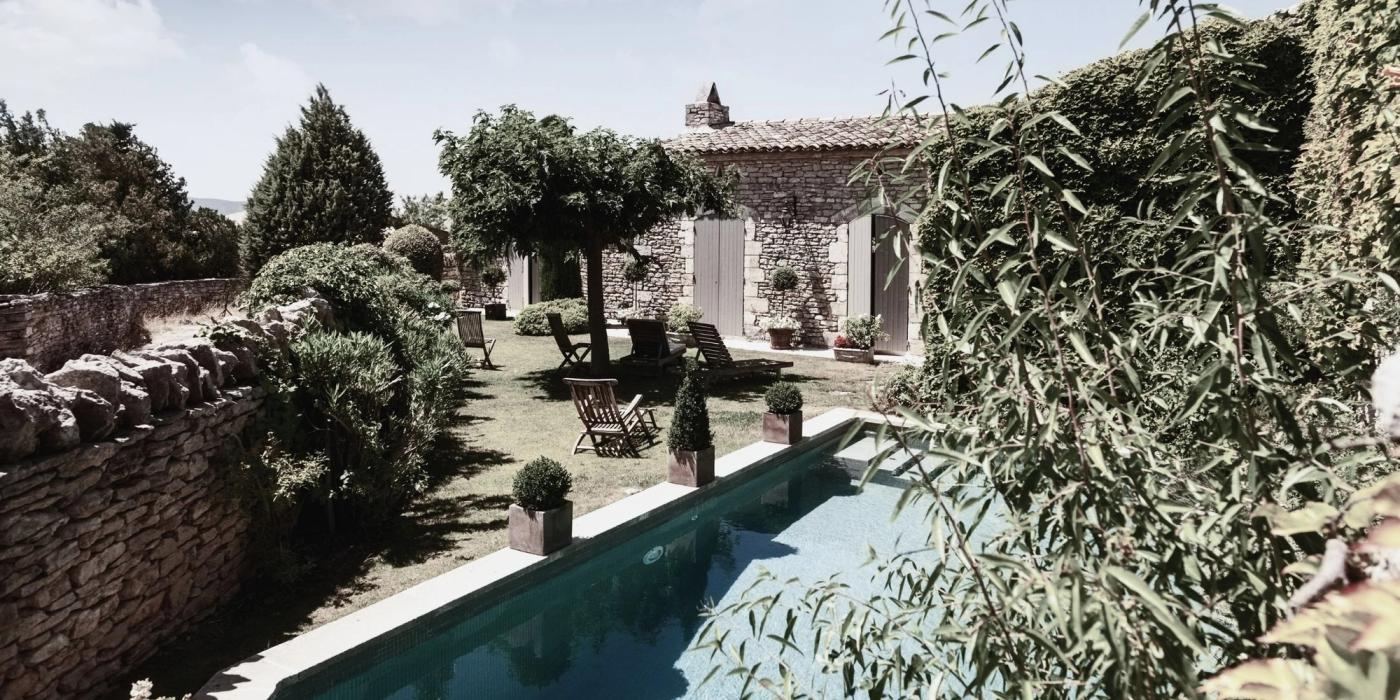
The Luberon Massif, classified as a Regional Natural Park, contains some of France’s most internationally recognized villages: Gordes, Ménerbes, Bonnieux, Lacoste, Lourmarin. Real estate here combines scarcity, beauty, and a well-established international buyer community. Prices are supported by persistent demand and a limited pool of sellable properties. We have dedicated a full Luberon buying guide to this market, which covers the specific due diligence considerations unique to this zone.
Aix-en-Provence: Urban Elegance & Investment Potential
Aix-en-Provence is arguably the most complete city in southern France. It offers a functioning urban economy (university, technology corridor, corporate headquarters), cultural infrastructure, excellent transport links via TGV to Paris in 3 hours, and a property market with genuine depth. For buyers who want Provence without sacrificing urban functionality, Aix is the rational choice. The hôtels particuliers of the Quartier Mazarin represent the city’s prestige tier, with prices regularly exceeding €8,000/m² for fully restored 18th-century architecture.
Alpilles: Countryside Charm Near Saint-Rémy-de-Provence
The Alpilles chain of limestone hills west of the Luberon has its own distinct identity: drier, more mineral, and anchored by the elegant market town of Saint-Rémy-de-Provence. The buyer profile here leans toward artistic and cultural buyers, and the market is smaller and more intimate than the Luberon. Prices are broadly comparable, though the available stock is more limited.
L’Isle-sur-la-Sorgue & the Sorgue Valley
L’Isle-sur-la-Sorgue is the antiques capital of France and offers a more accessible entry point into Provence real estate than the premium Luberon villages. The Sorgue Valley as a whole, including Fontaine-de-Vaucluse and Gordes to the north, offers a layered market with options at every budget level.
Var & Verdon: Emerging Markets in Provence
The Var département and the Verdon Gorge area represent Provence’s most dynamic emerging market. Lower land prices, improving infrastructure, and growing interest from both French and Northern European buyers are creating conditions for medium-term capital appreciation. For buyers with a 7 to 10-year horizon, this zone merits serious attention.
Coastal Provence: Cassis, La Ciotat & Marseille Surroundings
The Calanques coastline between Marseille and Cassis is among the most spectacular in Europe. Real estate here is dominated by cabanons (traditional small summer houses), villas with sea access, and increasingly, high-end residential developments. The Marseille metropolitan effect is also relevant: as France’s second city continues its urban renewal, peripheral coastal communes are benefiting from proximity to improved economic infrastructure.
Buying Property in Provence: Step-by-Step Guide
Buying in France as a non-resident involves a structured legal process that differs materially from Anglo-Saxon conveyancing. The key stages are as follows:
- Define your budget and net acquisition cost: Include notary fees (7 to 8% for existing properties), agency commissions if applicable, and renovation reserves.
- Establish your legal structure before making offers: Whether you buy in personal name, via an SCI (Société Civile Immobilière), or through a holding company has tax and inheritance implications that cannot easily be reversed post-purchase.
- Engage a property hunter or advisory firm: A buyer’s agent with exclusive mandate to you has no conflict of interest with the seller, unlike a traditional agency operating on dual mandate.
- Sign the Compromis de Vente: This preliminary contract is legally binding on both parties. A 10-day cooling-off period applies to individual buyers. Conditions precedent (suspensive conditions) for financing must be included here.
- Notary due diligence period (typically 2 to 3 months): The notaire verifies title, surveys, planning permissions, and prepares the final deed.
- Sign the Acte Authentique: Final deed of sale signed before the notaire. Funds are transferred, and keys are handed over.
Legal & Financial Considerations for Buyers
French Property Taxes
- Taxe foncière: Annual land and property tax payable by the owner. Varies by commune, typically €1,500 to €6,000 per year on a substantial rural property.
- Taxe d’habitation: Abolished for primary residences since 2023, but still applicable in some configurations for secondary residences in designated “tense” zones.
- IFI (Impôt sur la Fortune Immobilière): France’s wealth tax applies to net real estate assets exceeding €1.3M held in France. This is a critical consideration for high-net-worth buyers and warrants specific tax advisory before acquisition.
Notary Fees & Transaction Costs
Total acquisition costs on an existing property in France typically run to 7 to 8% of the purchase price, comprising notary fees, registration duties, and administrative charges. On new-build properties, this drops to approximately 2.5 to 3%. For a detailed breakdown, we recommend reviewing our analysis of buying costs.
Financing for Non-Resident Buyers
French banks will lend to non-residents, typically up to 70 to 80% LTV at current rates of 3.5 to 4.5% (fixed, 20-year term, as of early 2025). The debt service-to-income ratio threshold is 33 to 35% of gross income. Non-residents with income primarily denominated in USD or GBP will need to present tax returns from their home jurisdiction and demonstrate a stable professional situation. Some specialized brokers can access private bank financing with more flexible criteria for ultra-high-net-worth buyers.
SCI Property Structures
An SCI (Société Civile Immobilière) is a French civil property company used to hold real estate. It is not a tax optimization vehicle in isolation, but it provides significant advantages for estate planning, particularly for non-EU buyers subject to complex inheritance rules. An SCI allows you to divide ownership into shares that can be gifted progressively to heirs, bypassing the rigid French succession framework that would otherwise apply to direct ownership by a foreign national.
Renting Out Your Provence Property
Provence is one of France’s premier tourism regions, and short-term rental demand is structurally robust. A well-presented mas with pool in the Luberon will command €5,000 to €15,000 per week during July and August. Annual gross rental income on a €1.5M property operated professionally can realistically reach €60,000 to €80,000.
Key operational considerations:
- Seasonal licensing requirements apply in many communes following the 2024 amendments to French short-term rental legislation
- Professional property management fees typically run 20 to 25% of gross rental income
- Non-resident landlords are subject to French income tax on French-source rental income, regardless of tax residency
- Energy performance (DPE) requirements are increasingly affecting the rentability of older properties requiring renovation
Living in Provence: Practical Information
Transport Links
- Marseille Provence Airport (MRS): International connections including direct routes from London, Amsterdam, New York (seasonal), and multiple Gulf hubs via Paris connection
- Aix-en-Provence TGV Station: Paris in 3 hours; connection to Lyon, Brussels, and London via Eurostar
- A7 and A8 motorways: Access to the full Provence-Alpes-Côte d’Azur region within 2 hours by car
International Schools & Education
The Aix-Marseille metropolitan area hosts several bilingual and international school options. For families requiring full IB curriculum in English, the nearest flagship options are in Marseille and Nice. This is a relevant factor for buyers considering Provence as a primary family residence rather than a seasonal asset.
Healthcare
Provence benefits from strong public healthcare infrastructure through the CHU (Centre Hospitalier Universitaire) in Marseille and a network of regional clinics. Private health insurance is advisable for non-EU residents and can be structured affordably.
Working With Provence Real Estate Agencies
Property Hunters vs. Traditional Agents
The fundamental distinction that international buyers frequently underestimate is the difference between an agent working for the seller and an advisor working exclusively for the buyer. Traditional real estate agencies in Provence, whether national networks or independent boutiques, earn their commission from the transaction. Their commercial interest is completion, not your optimal outcome.
A property hunter or buyer’s advisor charges a fee (typically 2 to 3% of the acquisition price) and is contractually aligned with the buyer’s interest. In a market where 30 to 40% of prime transactions are off-market, this distinction has direct financial consequences.
When evaluating any agency or advisor in Provence, ask:
- Do you hold a carte professionnelle (T card) issued by the CCI?
- Are you bound by a professional liability insurance (RCP)?
- Do you have access to off-market listings, and how is that access structured?
- What is your specific experience with non-resident buyers from our jurisdiction?
Online Portals vs. Local Intelligence
Platforms such as SeLoger, Leboncoin, and Rightmove France provide useful market orientation but represent only the publicly listed portion of available stock. In the prime Luberon and Alpilles markets, the most interesting properties often change hands before any online listing is created. This is not a myth: it is a structural feature of a market where long-standing relationships between local notaires, proprietors, and trusted advisors determine who gets first access.
Provence real estate is not a simple market to navigate remotely, and the stakes of a misinformed acquisition are significant. The asymmetry of information between a motivated international buyer and an experienced local seller is real. But it is also bridgeable, provided you build the right advisory structure before you begin your search. At Maison Arboris, our mandate is simple: to ensure that the property you acquire reflects your objectives precisely, that the price you pay reflects reality, and that the legal and financial structure protecting your ownership is optimal from day one.
Frequently asked questions
01Is there a European version of Zillow for searching Provence properties?
Is there a European version of Zillow for searching Provence properties?
No direct European equivalent to Zillow exists. In France, buyers use SeLoger, Leboncoin, and Rightmove France for listed properties. However, in prime Provence markets like the Luberon, 30 to 40% of transactions occur off-market, making a local buyer's agent far more valuable than any portal.
02What is the average price per square meter for property in Provence in 2026?
What is the average price per square meter for property in Provence in 2026?
Prices vary significantly by location. Premium Luberon villages like Gordes range from €6,000 to €9,000 per square meter. Aix-en-Provence apartments average €5,000 to €7,500 per square meter, while the Var corridor offers more accessible entry points between €2,200 and €3,800 per square meter.
03Can foreigners buy property in Provence, France?
Can foreigners buy property in Provence, France?
Yes, there are no restrictions on foreign nationals purchasing property in France. Non-residents can also access French mortgages at up to 70 to 80% LTV. However, buyers should establish their optimal legal structure, such as personal ownership or an SCI, before signing any preliminary contract to avoid costly restructuring later.
04What are the total buying costs when purchasing property in Provence?
What are the total buying costs when purchasing property in Provence?
Total acquisition costs on an existing Provence property typically reach 7 to 8% of the purchase price, covering notary fees, registration duties, and administrative charges. New-build properties attract lower costs of approximately 2.5 to 3%. A buyer's agent fee of 2 to 3% should also be factored into your total budget.
05What rental income can I expect from a Provence property?
What rental income can I expect from a Provence property?
A well-presented mas with a pool in the Luberon can command €5,000 to €15,000 per week during peak summer months. On a €1.5M property professionally managed, annual gross rental income can realistically reach €60,000 to €80,000. Professional management fees typically run 20 to 25% of gross income.